A community where self-responsibility replaces self-blame
There is a particular kind of discouragement that comes from understanding your patterns and still falling back into them, even after you have invested time, energy, and intention into changing.
It’s one thing to take in information and begin to understand that your behaviors make sense. It’s another thing entirely to integrate that information and start living as a new version of yourself. You may understand your Adapted Self and how it formed, but that doesn’t mean you will automatically begin operating as your Expansive Self.
That doesn’t mean you are incapable of change. It means you are trying to change without having the necessary conditions to do so. For most of us, change requires consistent support, reflection, and relationship.
The You’re Not the Problem Community is a place where we practice living differently together, and you’re invited to be a part of it.
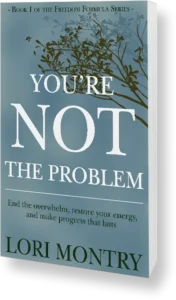
Inside this Community, we move through the You’re Not the Problem book together, so that its message and practices don’t become just another book on your bookcase collecting dust. Our weekly meetings give you a framework to change how you see yourself and how you move through your days. The ideas become shared language, and the practices become reference points. Over time, what once felt like mere insight becomes lived experience.
Because this Community works directly with the You’re Not the Problem book, you will want a copy to fully participate in the conversations and practices.
If you don’t already have a copy, you can purchase one here:
As a member of the Community, you will receive the downloadable companion workbook, which is normally $12.97, as a welcome gift. It will be sent directly to your inbox when you join, so you can begin engaging with the material right away.
Every Monday evening from 5:00 pm – 6:00 pm MST, we gather live via Zoom and anchor in the core pillars of the You’re Not the Problem framework: safety within the nervous system, capacity to hold discomfort and change, and energy to thrive and follow through. We apply the tools and practices directly to what unfolded in your week.
If you are unable to attend live, replays are available so you can stay connected to the work and the group.
We look carefully at the moments where pressure rose in your body, where survival mode shaped your response, where you may have overridden your own limits, and where you were able to pause and choose differently. Rather than analyzing from a distance, we slow those moments down and work with them until they make sense, and you see how a new choice is available.
As this practice continues, you’ll soon begin to notice the early signs of stress, overwhelm, and triggers. You recognize bracing before it turns into reactivity and become aware of self-abandonment before it becomes resentment. You also develop the capacity to feel discomfort without immediately escaping it with food, wine, shopping, scrolling, working, or other distractions. The work stops being about trying to improve yourself and starts being about relating to yourself in a more supportive and regulated way.
Over time, your life starts to change in noticeable and liberating ways. People realize that they are less reactive in conversations that used to escalate. They follow through on commitments they once avoided because overwhelm no longer shuts them down. Coping behaviors that once felt automatic are no longer needed as the nervous system develops what it needs from within. Sleep improves, and even decision-making becomes clearer. Perhaps best of all, the internal argument that once ran all day quiets down. These changes make everyday life feel more manageable.
When you attempt to shift long-standing adaptations in isolation, it is easy to slip back into self-criticism or to believe that your struggles are uniquely yours. Your Adapted Self can convince you that you are behind, that you should be further along, or that everyone else has figured something out that you have not.
When you come together with other people who are learning to say, without shame, that they are adaptive rather than broken, your nervous system registers that as a cue of safety. You begin to experience connection and co-regulation while you are actively examining your patterns, and that changes how deeply you can engage in the work. With healthy curiosity, shame begins to melt, and your perspective widens. You start to see yourself more clearly and more compassionately.
Rather than a weekly motivational call or a place to perform, the You’re Not the Problem Community is a steady structure where you return each week to reflect, practice, recommit, and build internal consistency.
We keep it interesting and engaging with guest speakers, exploration of the specific patterns that drive us all crazy, and regular individual support. There is space for dialogue, questions, and real-life application. Some people remain here for years because it provides the long-term support that makes change possible. Others begin in the community and later decide they want more individualized depth. Either way, this Community becomes a place where change is reinforced rather than restarted.
This Community is the home of the You’re Not the Problem Movement.
We come together from different neighborhoods, cities, states, and nations, yet we are united by a shared understanding that we are not the problem. When enough of us can stand in front of a mirror and say that without hesitation, the world can change. The way we parent, partner, and lead uplevels. The way we move through uncertainty and conflict shifts, too.
We may not have immediate answers for the larger suffering we see in the world, and none of us alone can solve the complexity of what is unfolding around us. What we can do is become more respectful of our own nervous system and capacity, as well as the nervous systems and capacity of those around us. We can learn to recognize survival adaptations rather than projecting them outward. We can interrupt shame rather than spreading it. We can model nervous system steadiness in our homes, workplaces, and communities.
A trauma-informed, somatic-literate world begins with individuals like you who are willing to examine their own patterns and practice self-regulation. It begins when relief from adaptation takes hold in your own life and spreads outward to your corner of the world.
By joining the community, you become part of a collective commitment to live differently and reshape our world from hustle culture to something more human.
If you are ready to engage with this work in a way that is supported, relational, and grounded in your daily life rather than in theory, this is a place to begin.
The changes inside this Community are shared week after week. These small but mighty victories remind us all that little hinges swing big doors.
Nancy lost nearly 100 pounds.
Anne lost 94 pounds.
Alice stopped defaulting to people-pleasing and began honoring her own limits.
Shannon stopped drinking four or more nights a week.
Mindy took her power back at work and, instead of feeling stressed and shut down every day, received a promotion and a raise.
Wendy navigated her divorce in a way that left her feeling hopeful and confident about the future.
These are the kinds of shifts that happen when people consistently engage in the work as nervous system regulation replaces survival-based coping.